

Source: blogs.vmware.com
While artificial intelligence unlocks transformational potential, enterprise adoption remains limited. Privacy, intellectual property (IP) protection, and regulatory compliance pose serious existential threats. Organizations must enforce granular access boundaries and protect proprietary data. The rapid shift toward agentic artificial intelligence significantly amplifies these fundamental issues, creating critical operational, cost, and governance challenges. Unlike traditional single-invocation inference models, autonomous agents operate in dynamic loops that drive unpredictable, non-linear growth in token costs and overwhelm legacy IT infrastructure.
New Challenges Emerge in the Era of Agentic AI
In the era of agentic AI, companies face additional challenges that must be overcome.
- Operational Complexity: Agentic workloads behave differently than traditional inference requests. Agents chain together dozens of model calls, tools, and reasoning loops. Traditional infrastructure was simply not designed for such prolonged, dynamic demand. Deployment challenges include:
- Day 0 Deployment: compute resources, networking, storage, Kubernetes, and fabric infrastructure.
- Day 2 Operations: lifecycle management, including patching, updating, model versioning, and framework migration, turns into continuous parallel loops rather than discrete projects.
- Surging Token Costs: AI agents operate in looped iterations, so token consumption grows non-linearly. In fact, token costs are forecast to increase by 24x by 2030. Context bloat, multi-agent communication, error correction, reflection, and internal reasoning prompts are examples of why token spend escalates unpredictably. Pay-per-token public cloud LLMs have seen an unexpected surge in costs.
- Governance Gaps: Engineering teams are building applications and deploying autonomous agents faster than privacy, security, governance, and operations processes can keep up. This has created a fragmented environment where leaders may lack a centralized view of exactly which models, tools, and agents are being used, and how infrastructure should enforce granular privacy, infrastructure, and data access controls—limiting what each agent can access and modify, even if the underlying model itself is trusted.
VMware Private AI Cloud
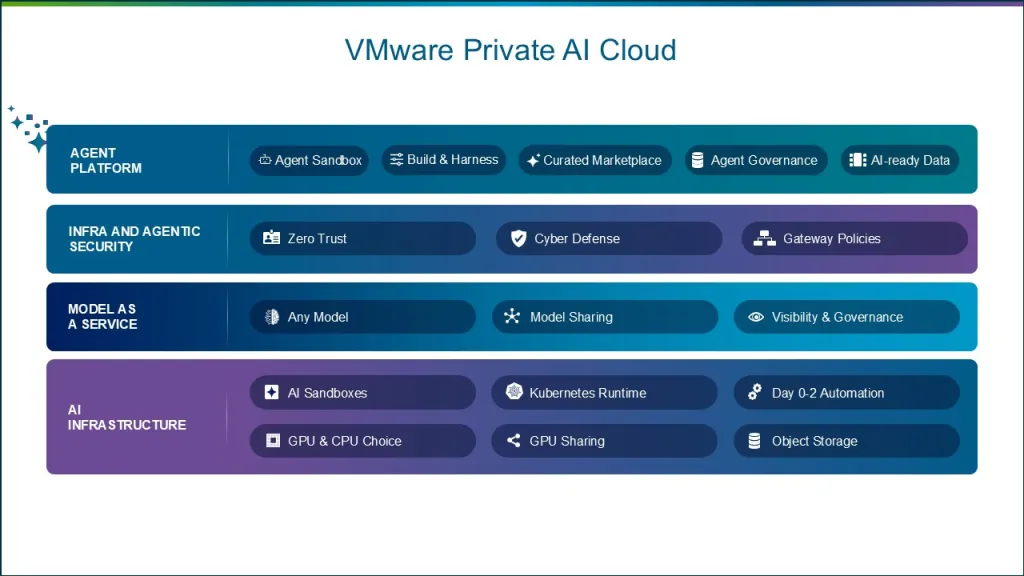
To address these challenges, Broadcom introduced VMware Private AI Cloud, enabling enterprises to cost-effectively scale AI, operate more securely, and innovate rapidly. Built on Broadcom’s advanced software capabilities, the VMware Private AI Cloud platform provides organizations with a production-ready pathway to securely build, run, and manage inference workloads, agentic applications, and traditional enterprise workloads together on VCF, offering a broad choice of hardware, models, and accelerators.
- Cost-Effectively Scale AI: VMware Private AI Cloud addresses the three primary cost drivers of AI: hardware CapEx, operational complexity, and tokenomics. VCF supports GPUs, CPUs, and accelerators from leading vendors, as well as server hardware from major OEM and ODM manufacturers, enabling customers to cost-effectively run heterogeneous clusters. To optimize tokenomics and resource utilization, it offers token monitoring, multi-tenant model sharing, advanced GPU/vGPU tracking, and an AI metrics observability dashboard. One of the key innovations of VMware Private AI Cloud is VMware AI Factory, delivering a fast track from bare metal deployment to first model serving.
- Operate More Securely: Built with a defense-in-depth approach aligned with NIST CSF 2.0, VCF defends against AI-amplified threats by minimizing the attack surface and ensuring continuous compliance. Automated non-disruptive updates keep systems current, while VMware vDefend utilizes virtual patching and hypervisor-level lateral security with micro-segmentation to implement Zero Trust and block exploits. Additionally, vDefend’s multi-layered threat protection along with VMware Avi Load Balancer’s Web Application Firewall (WAF) and API protection prevent sophisticated attacks.
- Innovate Rapidly in the Era of Agentic AI: Unlike traditional applications, autonomous AI agents can act unpredictably, exceed authorization limits, or misinterpret instructions. Consequently, trust depends on robust controls and data integrity. VMware Tanzu Platform, together with VMware vDefend, provides the foundation for trustworthy enterprise agents through a deny-by-default architecture, pre-configured harness environment, and curated marketplace.
Let’s take a closer look at VMware AI Factory — a key innovation in VMware Private AI Cloud.
VMware AI Factory: Fueling VMware Private AI Cloud
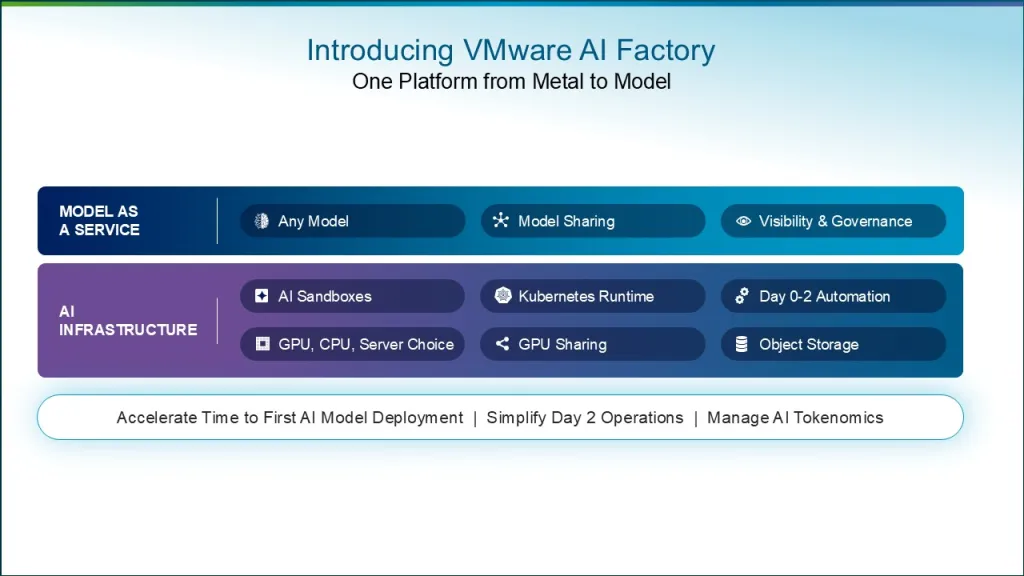
VMware AI Factory is the software-defined foundation of VMware Private AI Cloud. It provides customers with a streamlined path to production AI through new automation innovations for deploying AI-ready infrastructure and supporting Day 2 operations. With VMware AI Factory, customers can accelerate time to first model deployment and better manage AI tokenomics.
VMware AI Factory brings AI applications directly to private enterprise data in a secure private cloud environment. VCF’s unique infrastructure automation capabilities cut the time from bare metal server provisioning to serving the first AI model from weeks down to hours. VMware AI Factory streamlines AI infrastructure management by fully automating hardware provisioning, software stack activation, and end-to-end lifecycle management. By unifying hardware and software operations into a single automated solution, organizations can rapidly scale AI workloads while minimizing operational complexity.
To make IT infrastructure deployment fast and secure, trust VCF deployment to professionals. Contact Wise IT experts — an official partner of VMware by Broadcom — for a consultation to design a reliable and optimized infrastructure for your innovations. Get in touch with us today and unlock the potential of artificial intelligence for your business without unnecessary risks:
Partnerships Enabling VMware AI Factory
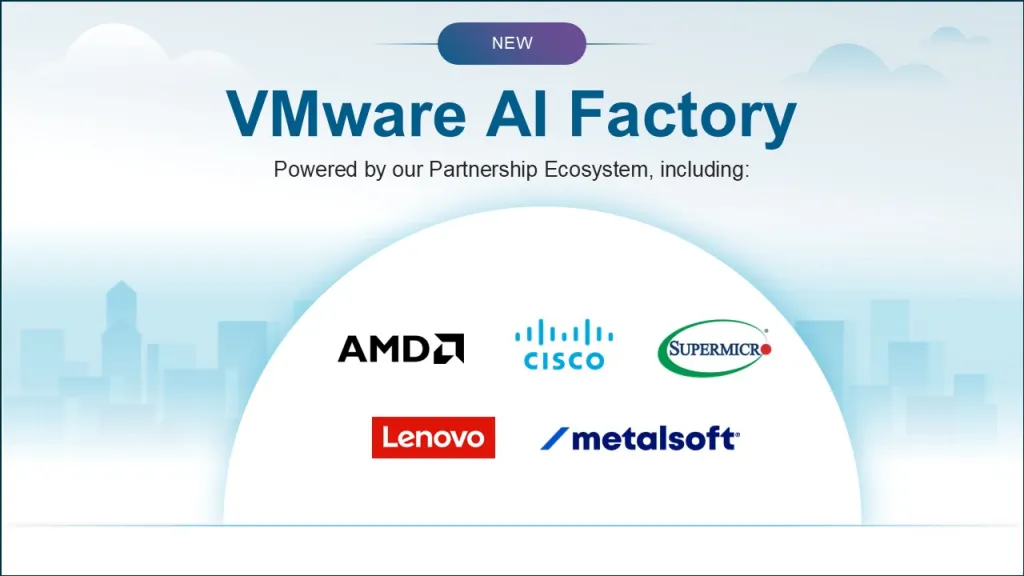
VMware AI Factory combines VCF with certified Dell PowerEdge servers and VCF AI ReadyNodes from Cisco, Lenovo, Supermicro, and others, alongside customers’ preferred AI software and accelerator architectures.
Broadcom and AMD are collaborating to build VMware AI Factory, combining VCF with AMD Instinct GPUs and the open AMD ROCm software ecosystem. Zero-touch provisioning will orchestrate end-to-end deployment of the complete stack—from vSphere and vSAN to Kubernetes and the AMD GPU operator—while the AMD DVX driver will attach GPUs to large VMs used by the VMware vSphere Kubernetes Service cluster.
To further simplify VCF AI Factory deployment, Broadcom announced a new partnership with MetalSoft to deliver integrated heterogeneous bare metal automation for VCF, reducing physical server provisioning time from weeks to minutes. This integration helps IT professionals deploy or repave multi-vendor physical servers directly through the VCF management console, unifying software and hardware lifecycles into a single operational model and eliminating the need for vendor-dependent hardware and firmware management tools.
New Capabilities Delivered to VMware AI Factory
VMware Cloud Foundation (VCF) Private AI Services help make AI operational, manageable, and cost-effective, and are included with VCF. VMware by Broadcom continues to expand the range of services offered through VCF Private AI Services. Let’s take a closer look at these capabilities.
Generally Available
Multi-Tenant Model Sharing
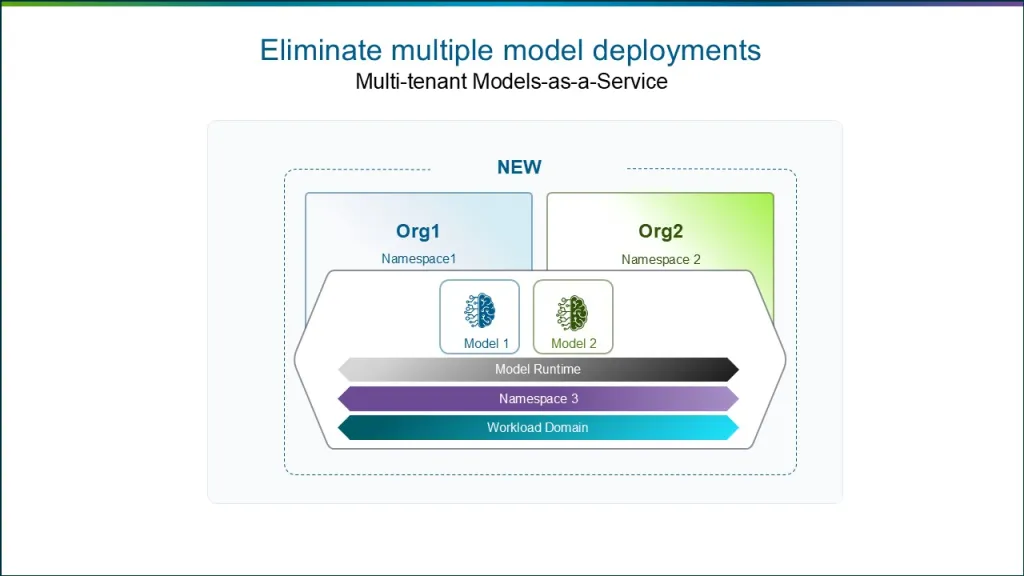
In the VCF 9.1.1 release, Model Runtime has been enhanced to securely share AI models across tenants or individual business units within their namespaces while maintaining complete data privacy for each. In practice, this means enterprises and cloud service providers can now run a single Model Runtime service that executes and scales models across the entire organization, while each team or business unit maintains separate private and secure namespaces for their sensitive data. This capability eliminates the need to deploy redundant model instances, which wasted GPU and infrastructure resources. It also preserves data privacy and isolation while optimizing total cost of ownership (TCO).
Future Release Capabilities
AI Gateway
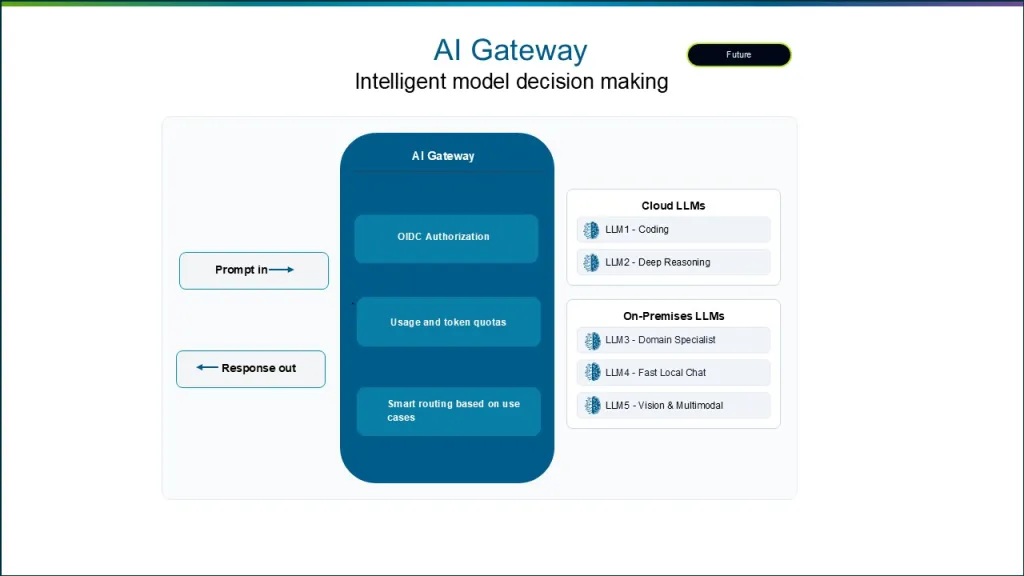
To balance today’s trade-offs around token cost optimization, use cases, and performance, enterprises need both cloud and on-premises models. Public cloud LLMs can suffer high token consumption, making governance paramount. The AI Gateway functionality will significantly help address these trade-offs. Let’s look at the details:
- Intelligent prompt routing: dynamically distributes incoming requests between the most suitable on-premises or cloud models based on factors such as use cases, domain specialization, and token cost to optimize performance.
- Usage and token rate limiting: rate limiting on usage and tokens at the user level helps minimize token consumption.
- Application authorization: identifies the requesting application prior to routing the prompt. AI Gateway leverages OpenID Connect token-based authorization to enforce access control.
Secure Agent Framework
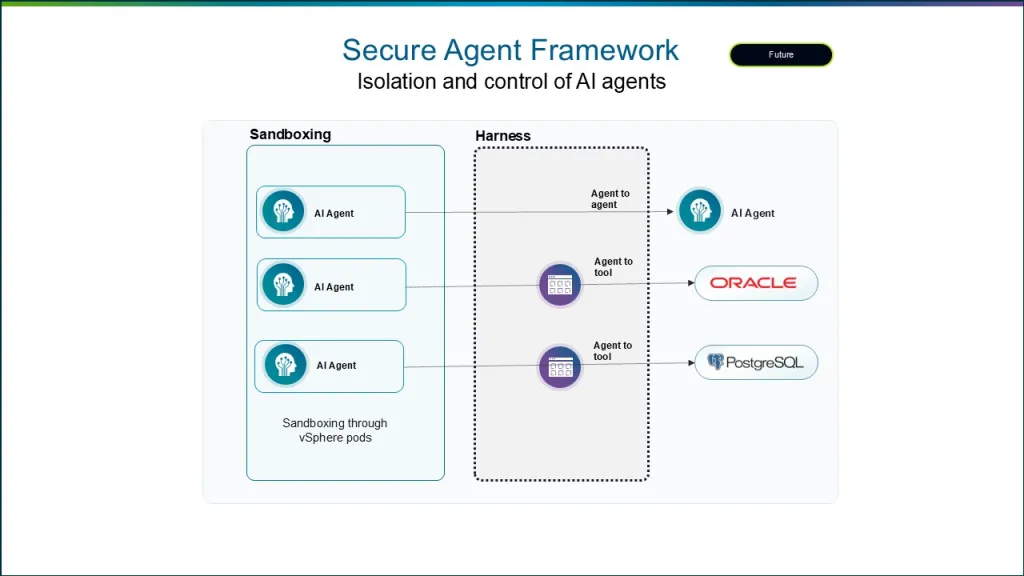
Autonomous AI agents dynamically generate and execute code, which poses significant security risks in the absence of strict controls. An unconstrained agent without deterministic access boundaries could inadvertently execute catastrophic commands, such as deleting VMs or wiping on-premises databases, as demonstrated by rogue test agents from several cloud AI vendors.
We will release two complementary capabilities to ensure control and protection for AI agents:
- Sandboxing: creates a secure virtualized container space where agent-generated dynamic code is isolated and executed without impacting the broader environment.
- Agent Harness: provides a management layer that defines how agents are invoked, what tools they can access, how they interact with each other, and how their outputs are validated prior to taking actions.
Model Autoscaling
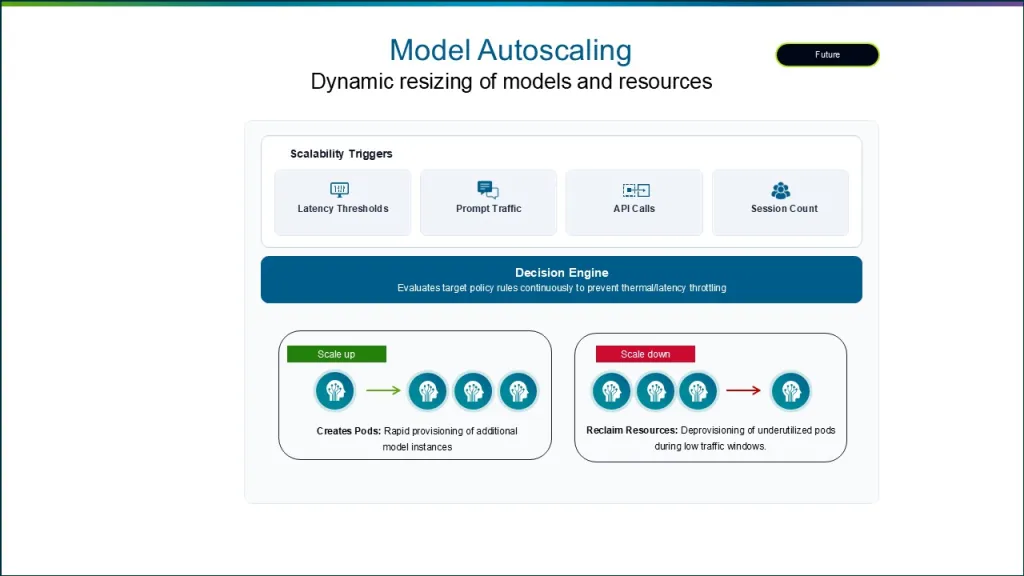
AI workloads cannot dynamically respond to sudden spikes in requests or agentic loops. To resolve this, we are introducing Model Autoscaling. With this feature, an admin or AI operator can set threshold values for latency and sessions, and the AI model will automatically scale when these thresholds are met to maintain latency and performance SLAs. When usage drops below the threshold, the workload scales down.
With this capability, enterprises gain improved performance and lower TCO through event-based scaling that keeps token latency low and prevents GPU over-provisioning. Organizations can further optimize their AI investments by sharing expensive GPU resources more efficiently across diverse workloads.
Additional AI Innovations and Announcements from Explore
Broadcom’s Support for a Wide Variety of Models Delivered Through VCF
The AI landscape is evolving rapidly and requires model diversity. The need for AI model variety is driven by several factors, including privacy, security, governance, token costs, specialization, and domain expertise.
Broadcom is committed to helping enterprises navigate these factors by supporting both open-weight models and purely commercial solutions. VMware AI Factory provides enterprises with a turnkey path to run leading AI models on-premises. Leveraging vLLM as the default model runtime gives customers the ability to run over 150 open-source models optimized for performance on VCF. Today, Broadcom is announcing that the following models have been validated to run on VCF:
- Nemotron 3: The NVIDIA Nemotron 3 family of open multimodal models delivers leading accuracy and efficiency, helping agents complete tasks faster. Combining a hybrid Mamba-Transformer MoE architecture, a 1M-token context window, and multi-environment reinforcement learning, Nemotron 3 enables scalable, long-running agentic workflows in enterprise applications.
- Gemma 4: The newest family of multimodal open-source and open-weight models from Google DeepMind, purpose-built for developers and the research community to enable local execution, empowering enterprises to build and deploy autonomous AI agents.
- cotomi: NEC’s proprietary AI model optimized for the Japanese language, trained on curated, highly reliable datasets. It empowers enterprises by seamlessly combining high-speed processing with a 40% improvement in token efficiency.
- Qwen3.8-27B: Alibaba’s Qwen3.8-27B model is an open-weight, dense vision-language model in the Qwen series. Suitable for coding, professional workflows, research, multimodal interaction, and long-horizon agent tasks, with flexible reasoning that can be toggled on or off. It is a native multimodal dense model with 27 billion parameters, designed for efficient local deployment and commercial use.
- GLM 5.2: The open-source General Language Model from Z.ai (formerly Zhipu AI) enables enterprises to deploy coding and reasoning agents locally for multi-step autonomous workflows, ensuring data sovereignty and optimal hardware performance.
VCF Achieves NVIDIA Certification: AI Workload Performance Validated to Operate at Near Bare Metal Performance
NVIDIA recently introduced the NVIDIA-Certified Hypervisors program. This program certifies that included hypervisors deliver near-bare-metal performance for AI and High-Performance Computing (HPC) workloads.
VMware vSphere 9.1 (and all future vSphere 9 releases) achieved NVIDIA-Certified Hypervisor status. AI and HPC workloads on VCF are now certified to run at near bare-metal performance. This certification enables customers to confidently rely on VCF as a performance-optimized private cloud platform supported by key ecosystem partners to power AI and accelerated computing applications in enterprise data centers.
Partners Added to the VCF Private AI Services Ecosystem
VMware by Broadcom continues to strengthen the enterprise AI ecosystem. Beyond core capabilities, VCF Private AI Services expands its reach through new strategic alliances:
- Appian: Appian delivers mission-critical AI automation, streamlining complex processes across large enterprises and government organizations. The Appian platform is renowned for its exceptional reliability and scalability, backed by over 25 years of deep operational experience. Documentation for installing Appian on VCF.
- ClearML: ClearML delivers an AI orchestration layer to manage GPU access, models, and agents within VMware Cloud Foundation. This improves GPU utilization and reduces the cost of running AI workloads, giving enterprises a built-in path to AI-as-a-Service. Learn more about ClearML here.
- Eve Security: Eve provides the governance, observability, and runtime control enterprises need to safely scale AI agents. With an agent-in-the-loop, it automatically validates high-risk or anomalous activity, enriches decisions with context from identity, DLP, and core systems, and enforces real-time controls when necessary. Learn more about Eve Security here.
- Solo.io: Builds open-source agentic infrastructure for enterprises running AI in production. The kagent runtime and agentgateway data plane empower platform teams to deploy AI agents and govern every model, tool, and inter-agent call on their own infrastructure. For more information about Solo.io and Broadcom, read this post.
- TrueFoundry: TrueFoundry provides an enterprise-grade AI Gateway featuring LLM Gateway, MCP Gateway, and Agent Gateway, enabling enterprises to connect, observe, and govern multi-provider agentic AI applications from a single control plane. For additional details on TrueFoundry, see here.
To make IT infrastructure deployment fast and secure, trust VCF deployment to professionals. Contact Wise IT experts — an official partner of VMware by Broadcom — for a consultation to design a reliable and optimized infrastructure for your innovations. Get in touch with us today and unlock the potential of artificial intelligence for your business without unnecessary risks: